
How to Choose a Clothing Manufacturer in Pakistan
Choosing the right clothing manufacturer is the difference between a brand that scales smoothly and one that drowns in quality complaints, missed deadlines and hidden costs. This guide covers the capability checks, the quality checks, and the commercial checks every apparel brand should complete before placing a production order in Pakistan.
Why Choosing the Right Clothing Manufacturer in Pakistan Is Critical
Pakistan is one of the world's largest apparel exporters, with a mature textile and garment manufacturing base. But the market is highly fragmented — from large, vertically integrated factories to small stitching units with limited capacity and inconsistent quality.
The manufacturer you choose determines your product quality, your production timelines, your cost per unit, and your ability to reorder consistently. A wrong choice costs you customers and money. A right choice becomes a long-term competitive advantage.
This guide walks through exactly what to check, in the order that matters — from production capability and quality control to MOQs, sampling and certifications.
- Production Capability
- Quality Control Systems
- MOQ & Pricing
- Sampling & Prototyping
- Certifications & Compliance
- Communication & Reliability
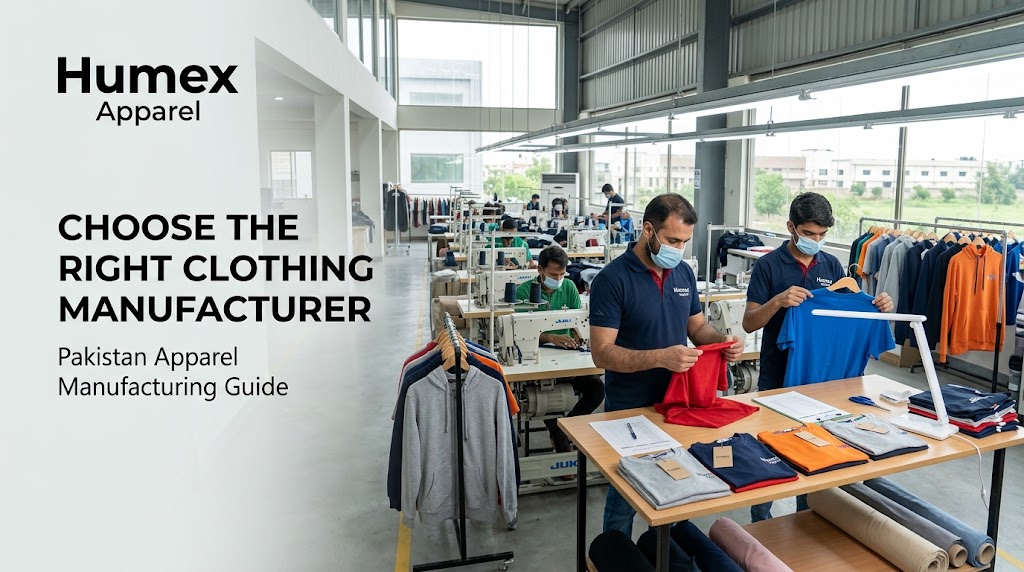
Six Things Every Brand Must Check Before Choosing a Manufacturer
These are the checks that separate a reliable manufacturing partner from one that causes problems later.
Production Capability
CapacityCan the manufacturer handle your order volume, product type and timeline? Capacity is not just about how many machines they have — it is about whether their production lines match your product category.
- Monthly production capacity
- Machinery and line setup
- In-house vs outsourced processes
- Experience with your product type
Quality Control Systems
QualityA manufacturer without a documented QC process produces inconsistent results — especially on repeat orders. Ask how they inspect fabric, cuts, stitching and finished goods.
- Incoming fabric inspection
- In-line and end-line QC
- AQL standards and defect rates
- Pre-shipment inspection process
MOQ & Pricing
CommercialMinimum order quantity and pricing structure determine whether a manufacturer fits your business model — especially for new or growing brands with limited initial volume.
- MOQ per style and per colour
- Price breaks by quantity
- What is included in the quote
- Payment terms and schedule
Sampling & Prototyping
DevelopmentA manufacturer's sampling process tells you how they will handle production. If sampling is slow, unclear or inaccurate, production will be too.
- Sampling lead time
- Sample cost and rebate policy
- Number of revision rounds
- Tech pack handling accuracy
Certifications & Compliance
ComplianceCertifications confirm that the manufacturer meets recognised standards for quality, labour practices and social compliance — which matters if you sell to international buyers or retailers.
- ISO or equivalent quality certification
- Social compliance audits
- Labour and safety standards
- Export documentation experience
Communication & Reliability
PartnershipA manufacturer who responds slowly during the enquiry stage will respond slowly during production. Communication quality is a direct predictor of reliability.
- Response time during enquiry
- Clarity of quotes and terms
- Order tracking and updates
- On-time delivery history
Match the Manufacturer to Your Product Category
Not every manufacturer produces every product type. Choose one with proven experience in your specific category.
Streetwear Manufacturing
Heavyweight tees, oversized fits, custom prints, embroidery and premium streetwear construction.
Streetwear ManufacturingSportswear Manufacturing
Performance fabrics, moisture-wicking materials, sublimation printing and team sportswear production.
Sportswear ManufacturingGym Wear Manufacturing
Compression wear, activewear sets, leggings, shorts and performance gym apparel built for durability.
Gym Wear ManufacturingT-Shirts Manufacturing
Custom t-shirt production in all fabric weights — cotton, blends, oversized fits and branded printing.
T-Shirts ManufacturingHoodies Manufacturing
Pullover and zip hoodies, fleece construction, custom embroidery and premium finishing.
Hoodies ManufacturingAmerican Football Uniforms
Custom football jerseys, pants, pads and team uniform sets built to withstand contact sport use.
Football UniformsRash Guards Manufacturing
Compression rash guards, UV-protective fabrics, flatlock stitching and sublimated designs for BJJ, MMA and water sports.
Rash Guards ManufacturingFull-Service Apparel Manufacturing
End-to-end production — fabric sourcing, sampling, bulk manufacturing, quality control and export packing.
Humex ApparelClothing Manufacturer Checks at a Glance
A practical reference table showing each check, what it confirms, and what to ask.
| Check | What It Confirms | What to Ask | Action |
|---|---|---|---|
| Production Capacity Capability | Whether the manufacturer can handle your order volume and product type. | Monthly capacity, machinery list, in-house vs outsourced processes. | Contact |
| Quality Control Quality | Whether finished goods meet consistent standards on every order. | In-line QC, end-line QC, AQL standards, defect rate history. | Contact |
| MOQ & Pricing Commercial | Whether the minimum order quantity fits your business model. | MOQ per style, per colour, price breaks, payment terms. | Contact |
| Sampling Process Development | How accurately and quickly the manufacturer can develop your product. | Sampling lead time, sample cost, revision rounds, tech pack handling. | Contact |
| Certifications Compliance | Whether the manufacturer meets recognised quality and labour standards. | ISO, social compliance audits, export documentation experience. | Contact |
| Communication Reliability | Whether the manufacturer will keep you informed and deliver on time. | Response time, order tracking, on-time delivery history. | Contact |
| Product Experience Category Fit | Whether the manufacturer has proven experience in your specific product type. | Past orders in your category, reference clients, samples. | Contact |
| Payment Terms Financial | Cash flow impact of the order and risk exposure. | Advance percentage, milestone payments, balance on delivery. | Contact |
Need Help Finding the Right Clothing Manufacturer?
Share your product type, target quantity and timeline. You will get clear guidance on what to look for — capability, quality, MOQ and compliance — before you commit to production.
Share Your Product Details
Tell us the product type, fabric preference and design requirements.
Send DetailsConfirm Your Order Volume
Your target quantity determines which manufacturers can realistically take the order.
Share VolumeConfirm Your Timeline
Tell us when you need delivery, so sampling and production can be planned in time.
Discuss TimelineRed Flags When Choosing a Clothing Manufacturer in Pakistan
If any of these appear, pause and get the issue independently verified before placing an order.
No Sampling Before Production
A manufacturer who refuses to produce a sample before bulk production is a serious risk. Never approve bulk without seeing and approving a physical sample first.
Unclear or Changing Pricing
If the quoted price changes between conversations or the quote does not clearly state what is included, expect hidden costs later.
Slow or Vague Communication
If responses are slow, incomplete or evasive during the enquiry stage, the same pattern will continue through production.
No Quality Control Process
A manufacturer who cannot explain their QC process in detail is likely to deliver inconsistent quality, especially on repeat orders.
Pressure to Pay Full Advance
Demanding full payment upfront before any sampling or production milestone is a major risk. Standard terms involve staged payments.
No Verifiable References
A legitimate manufacturer should be able to provide references or examples of past work. If they cannot, proceed with caution.
How to Evaluate a Clothing Manufacturer in Four Steps
A practical sequence that keeps your decision grounded in facts.
Verify Capability
Confirm the manufacturer's capacity, machinery and experience in your specific product category.
Request Samples
Order a physical sample and evaluate fabric quality, stitching, fit and finishing before proceeding.
Agree on Terms
Finalise MOQ, pricing, payment schedule, lead time and QC standards in writing.
Monitor Production
Request in-line and pre-shipment updates, and inspect finished goods against the approved sample.
Clothing Manufacturer Selection Checklist
- Production capacity confirmed against your order volume.
- Machinery and production lines match your product category.
- In-house vs outsourced processes identified.
- Quality control process explained — in-line, end-line and pre-shipment.
- AQL standards and acceptable defect rate confirmed.
- MOQ per style and per colour clearly stated.
- Pricing structure and what is included in the quote confirmed in writing.
- Payment terms and schedule agreed — no full upfront advance.
- Sampling lead time and cost confirmed.
- Physical sample approved before bulk production begins.
- Certifications and compliance documents verified.
- References or past order examples reviewed.
- Production lead time and delivery date agreed in writing.
- Order tracking and update schedule confirmed.
Frequently Asked Questions
Common questions brands ask about choosing a clothing manufacturer in Pakistan.
Why should I choose a clothing manufacturer in Pakistan?
Pakistan is one of the world's leading apparel manufacturing countries, with a mature textile supply chain, competitive labour costs and strong expertise in knitwear, sportswear and streetwear. Manufacturers here offer a strong balance of quality, capacity and price — especially for brands looking to produce at scale without the higher costs of manufacturing in Europe or North America.
What should I check first before choosing a manufacturer?
Start with production capability. Confirm that the manufacturer has the machinery, capacity and experience to produce your specific product type at your required volume. After capability, check their quality control process, MOQ, pricing structure and sampling process. A manufacturer who is strong on all four is a serious candidate.
How important is the sampling process?
Sampling is one of the most important checks. A sample tells you how the manufacturer interprets your tech pack, how they handle fabric and construction, and what their finishing quality looks like. If sampling is slow, inaccurate or poorly communicated, production will follow the same pattern. Never approve bulk production without a physical sample you have inspected and approved.
What is a reasonable MOQ for a new brand?
MOQs vary widely depending on the manufacturer and the product type. Large factories often require higher minimums per style and per colour, while smaller or mid-sized units may accept lower volumes. For new brands, look for a manufacturer who offers flexible MOQs without compromising on quality — and be clear about your growth plans so they can scale with you.
How do I verify a manufacturer's quality control?
Ask the manufacturer to explain their QC process in detail: how incoming fabric is inspected, how in-line and end-line checks are performed, what AQL standard they follow, and what their typical defect rate is. A manufacturer with a documented QC system will be able to answer these questions clearly. If they cannot, treat it as a warning sign.
What payment terms are standard in Pakistan's apparel industry?
Standard terms typically involve an advance payment to cover raw materials, followed by milestone payments during production and a balance on delivery or against shipping documents. The exact split depends on the manufacturer and order size. Be cautious of any manufacturer who demands full payment upfront before sampling or production milestones.
Do I need a manufacturer with certifications?
Certifications matter most if you sell to international retailers, distributors or buyers who require social compliance and quality audits. ISO or equivalent quality certifications and social compliance audits confirm that the manufacturer meets recognised standards for production and labour practices. Even if you do not need certifications today, a manufacturer who holds them is generally more organised and reliable.
How can I get help choosing a clothing manufacturer?
You can reach out directly through the contact page. Share your product type, target quantity and timeline, and you will get clear guidance on what to look for — capability, quality, MOQ and compliance — before you commit to production.
Ready to Choose a Clothing Manufacturer? Choose Right.
Share your product type, target quantity and timeline. You will get clear guidance on what to verify — capability, quality, MOQ and compliance — before you commit to production.
How to Choose a Clothing Manufacturer in Pakistan — Complete Guide
Pakistan has become one of the most important apparel manufacturing destinations in the world, with a mature textile supply chain and expertise spanning knitwear, sportswear, streetwear, activewear and team uniforms. For brands sourcing production, the country offers a strong combination of quality, capacity and competitive pricing. But the market is fragmented — from large, vertically integrated factories to small stitching units — and the manufacturer you choose directly determines your product quality, timelines and long-term scalability. This guide sets out exactly what to check before placing a production order.
Production capability: the first check
Not every manufacturer can produce every product type. A factory set up for basic knitwear may not have the machinery or expertise for performance sportswear, sublimation printing or compression garments. Before anything else, confirm the manufacturer's monthly production capacity, their machinery and line setup, which processes are handled in-house versus outsourced, and whether they have proven experience in your specific product category. If you are producing streetwear, for example, you need a manufacturer experienced in heavyweight fabrics, oversized fits and custom printing — not a general-purpose stitching unit.
Quality control systems
A manufacturer without a documented quality control process will produce inconsistent results, especially on repeat orders. Ask how they inspect incoming fabric, how in-line and end-line checks are performed, what AQL standard they follow and what their typical defect rate is. A reliable manufacturer will be able to explain their QC process clearly and provide details on pre-shipment inspection. This is one of the strongest signals of whether a manufacturer can deliver consistent quality at scale.
MOQ and pricing structure
Minimum order quantity and pricing determine whether a manufacturer fits your business model. Large factories often require higher MOQs per style and per colour, while smaller or mid-sized units may accept lower volumes. For new brands, this is often the deciding factor. Ask for the MOQ per style and per colour, the price breaks by quantity, exactly what is included in the quote, and the payment terms and schedule. Be cautious of any manufacturer who demands full payment upfront before sampling or production milestones.
Sampling and prototyping
Sampling is one of the most revealing checks. A sample tells you how the manufacturer interprets your tech pack, how they handle fabric and construction, and what their finishing quality looks like. Ask about sampling lead time, sample cost and whether it is rebated against bulk orders, how many revision rounds are included, and how they handle tech packs. If sampling is slow, unclear or inaccurate, production will follow the same pattern. Never approve bulk production without a physical sample you have inspected and approved.
Certifications and compliance
Certifications confirm that a manufacturer meets recognised standards for quality, labour practices and social compliance. This matters most if you sell to international retailers, distributors or buyers who require social compliance audits. ISO or equivalent quality certifications and social compliance audits are strong indicators of an organised, reliable manufacturer. Even if you do not need certifications today, a manufacturer who holds them is generally better structured and more capable of meeting international buyer requirements.
Communication and reliability
A manufacturer who responds slowly during the enquiry stage will respond slowly during production. Communication quality is a direct predictor of reliability. Evaluate response time during the enquiry, the clarity of quotes and terms, whether they provide order tracking and updates, and their on-time delivery history. A manufacturer who communicates clearly and proactively is far less likely to cause production delays or surprises.
Matching the manufacturer to your product category
Different product categories require different manufacturing expertise. When evaluating manufacturers, match them to what you actually produce:
- Streetwear — heavyweight fabrics, oversized fits, custom prints and embroidery. See streetwear manufacturing.
- Sportswear — performance fabrics, moisture-wicking materials and sublimation printing. See sportswear manufacturing.
- Gym wear — compression wear, activewear sets and durable performance construction. See gym wear manufacturing.
- T-shirts — cotton, blends, oversized fits and branded printing. See t-shirts manufacturing.
- Hoodies — fleece construction, pullover and zip styles, custom embroidery. See hoodies manufacturing.
- American football uniforms — contact-sport construction, custom jerseys and pants. See American football uniforms manufacturing.
- Rash guards — compression fabrics, flatlock stitching and sublimated designs. See rash guards manufacturing.
Red flags to watch for
The most common warning signs when choosing a clothing manufacturer are: refusal to produce a sample before bulk production, unclear or changing pricing, slow or vague communication, no documented quality control process, pressure to pay full advance upfront, and no verifiable references or past order examples. If any of these appear, pause and get the issue independently verified before placing an order.
How to protect yourself
A practical manufacturer-selection sequence looks like this:
- Verify production capacity against your order volume.
- Confirm machinery and production lines match your product category.
- Ask for a detailed explanation of the quality control process.
- Confirm MOQ per style and per colour.
- Get pricing, payment terms and lead times in writing.
- Request a physical sample before approving bulk production.
- Verify certifications and compliance documents.
- Request references or past order examples.
- Agree on order tracking and update schedule.
- Inspect finished goods against the approved sample before shipment.
For a full overview of manufacturing capabilities, visit Humex Apparel. To discuss your specific requirements, reach out through the contact page.
Get help choosing a manufacturer
If you would rather not work through every check yourself, you can share your product type, target quantity and timeline directly through the contact page. That is enough to give you clear guidance on what to verify before you commit to production.