
Best Printing Methods for Custom Clothing Brands
The printing method you choose determines your product's feel, durability, cost and how your brand is perceived. Screen printing, DTG, DTF, sublimation, heat transfer vinyl and embroidery all have specific strengths — and choosing the wrong one for your fabric, design or order size will quietly destroy your margin and your print quality. This guide compares each method on the criteria that actually drive the decision.
Why Printing Method Selection Is a Brand-Critical Decision
The printing method you choose shapes your brand in ways that go beyond cost. It determines how your product feels when a customer touches it, how it performs after 50 washes, and whether your brand is perceived as premium or commodity.
Screen printing delivers vibrant, durable results and becomes more cost-effective for larger orders with simple designs. Digital printing unlocks what screen printing cannot — no setup cost, unlimited colors, and per-shirt personalization make DTG/DTF the better call for small batches and orders under 24 pieces. Sublimation on polyester outlasts the garment itself. Embroidery provides a polished, professional look that over 53% of swag buyers find "very" or "extremely" interesting.
This guide walks through each method, what it's best for, and how to match the right technique to your fabric, design and order size.
- Screen Printing
- DTG Printing
- DTF Printing
- Sublimation
- Heat Transfer Vinyl
- Embroidery
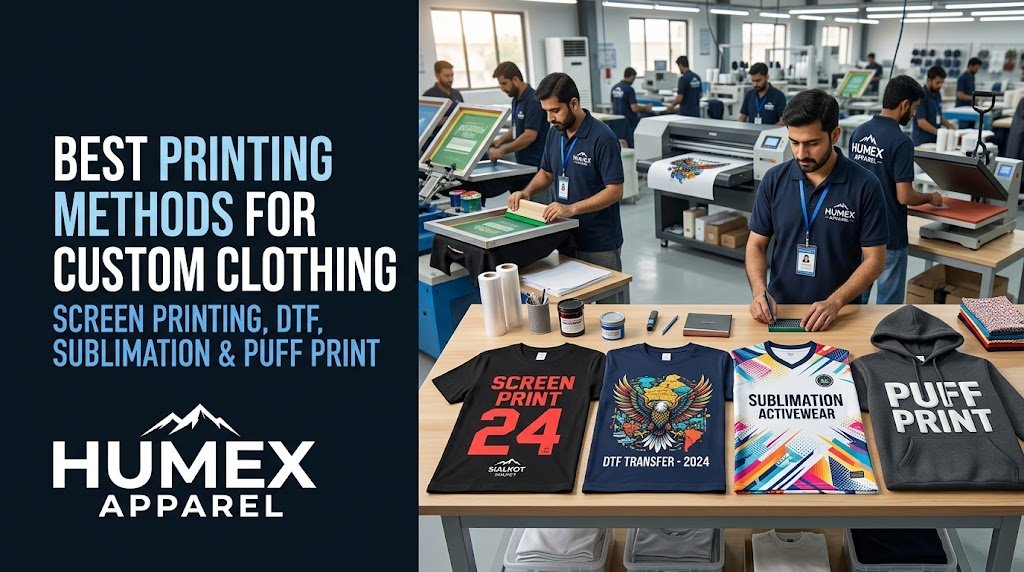
Six Printing Methods Every Clothing Brand Should Know
Each method has specific strengths. The right choice depends on your fabric, design complexity and order size.
Screen Printing
Bulk ChampionThe industry standard for bulk orders. Ink is pushed through a mesh screen, one screen per color. At volume, it is unbeatable on cost-per-print and durability.
- Best for: 50+ pieces, 1–4 spot colors
- Fabric: Cotton, blends, most fabrics
- Durability: Excellent — 50–100+ washes
- Hand-feel: Thick, visible ink layer
DTG Printing
Small-Batch WinnerDirect-to-Garment is essentially an inkjet printer for fabric. It sprays water-based ink directly onto the garment, making it ideal for small batches and complex designs.
- Best for: 1–23 pieces, photo designs
- Fabric: 100% cotton and cotton-rich blends
- Durability: 30–60 washes
- Hand-feel: Soft, almost no feel
DTF Printing
Versatile Middle GroundDirect-to-Film prints the design onto a release film, then transfers it to the garment with heat. It works on almost any fabric and is excellent on dark garments.
- Best for: 1–200 pieces, mixed fabrics
- Fabric: Cotton, polyester, blends, nylon
- Durability: 50–100+ washes
- Hand-feel: Medium — film layer softens
Sublimation
Performance & All-OverDye sublimation infuses color into polyester fibers at a molecular level. The result is a breathable, fade-proof, all-over design with zero hand feel that lasts the life of the garment.
- Best for: All-over prints, jerseys, sportswear
- Fabric: 65–100% polyester only
- Durability: Life of the garment
- Hand-feel: Zero feel — dye is in the fiber
Heat Transfer Vinyl (HTV)
PersonalizationHTV uses cut vinyl sheets applied with a heat press. It excels at personalization, names and numbers, and specialty effects like reflective or puff vinyl — but is not ideal for bulk production.
- Best for: 1–24 pieces, names/numbers
- Fabric: Cotton, blends, matched vinyl
- Durability: Medium — can peel over time
- Hand-feel: Thick, raised
Embroidery
Premium & ProfessionalEmbroidery uses thread stitched directly into fabric to create a textured, dimensional look that communicates quality and permanence. It is the go-to for polos, hats and workwear.
- Best for: Polos, hats, workwear, premium branding
- Fabric: Most fabrics suitable
- Durability: Excellent — outlasts the garment
- Hand-feel: Raised, textured, tactile
Printing Methods by Product Category
Match the printing method to your product category for the best results.
Streetwear Printing
Screen print, DTG and DTF for heavyweight tees, oversized hoodies and custom graphics.
Streetwear ManufacturingSportswear Printing
Sublimation for performance fabrics, team jerseys, all-over prints and moisture-wicking gear.
Sportswear ManufacturingGym Wear Printing
Sublimation and DTF for compression wear, activewear sets and performance gym apparel.
Gym Wear ManufacturingT-Shirt Printing
Screen print, DTG and DTF for custom t-shirts in all fabric weights and fits.
T-Shirts ManufacturingHoodie Printing
Screen print, DTF and embroidery for pullover and zip hoodies with custom branding.
Hoodies ManufacturingFootball Uniform Printing
Sublimation and tackle twill for custom football jerseys, pants and team uniform sets.
Football UniformsRash Guard Printing
Sublimation for compression rash guards, UV-protective fabrics and BJJ/MMA designs.
Rash Guards ManufacturingFull-Service Printing
End-to-end printing and manufacturing — screen print, DTG, DTF, sublimation and embroidery.
Humex ApparelPrinting Methods Comparison at a Glance
A practical reference table comparing all six methods on the factors that matter most.
| Method | Best For | Fabric | Durability | Hand-Feel |
|---|---|---|---|---|
| Screen Printing Bulk | 50+ pieces, 1–4 spot colors, bold designs | Cotton, blends, most fabrics | 50–100+ washes | Thick, visible layer |
| DTG Small Batch | 1–23 pieces, photo designs, full color | 100% cotton, cotton-rich blends | 30–60 washes | Soft, almost none |
| DTF Versatile | 1–200 pieces, mixed fabrics, dark garments | Cotton, polyester, blends, nylon | 50–100+ washes | Medium — softens |
| Sublimation Performance | All-over prints, jerseys, sportswear | 65–100% polyester only | Life of garment | Zero feel |
| Heat Transfer Vinyl Personalization | 1–24 pieces, names/numbers, specialty effects | Cotton, blends, matched vinyl | Medium — can peel | Thick, raised |
| Embroidery Premium | Polos, hats, workwear, premium branding | Most fabrics | Outlasts garment | Raised, textured |
Not Sure Which Printing Method Fits Your Brand?
Share your product type, fabric, design complexity and target quantity. You will get clear guidance on which method delivers the best balance of cost, durability and feel for your specific project.
Share Your Design Details
Tell us the design complexity, color count, fabric and product type.
Send DetailsConfirm Your Order Volume
Order size determines which printing method delivers the best value.
Share VolumeConfirm Your Timeline
Tell us when you need delivery so production can be planned accordingly.
Discuss TimelineCommon Printing Mistakes That Cost Brands Money
Avoid these pitfalls when selecting a printing method for your brand.
Choosing Screen Print for Small Orders
Screen printing requires a separate screen for each color. For orders under 24 pieces, the setup cost makes it uneconomical. Use DTG or DTF instead.
Using DTG on Polyester
DTG works best on 100% cotton. On polyester, the ink does not bond properly, leading to faded, washed-out prints that crack quickly.
Expecting Sublimation on Cotton
Sublimation only works on polyester (65%+). Untreated cotton cannot retain the dye permanently. The print will fade rapidly and wash out.
Not Testing Print Durability
Always wash-test a sample before bulk production. A print that cracks after 5 washes will generate returns and damage your brand reputation.
Mixing Methods Without Consistency
If you use different printing methods across a collection, the colors and feel may not match. Test across fabrics before committing to bulk.
Ignoring Setup Costs
Screen printing has per-color setup costs that are spread across the order. Always ask for a full cost breakdown before committing to a large run.
How to Choose the Right Printing Method in Four Steps
A practical sequence that keeps your printing decision grounded in facts.
Identify Your Fabric
Cotton suits DTG and screen print. Polyester is required for sublimation. DTF works on almost anything.
Count Your Colors
1–4 spot colors: screen print. Full-color or photographic designs: DTG, DTF or sublimation.
Know Your Order Size
1–23 pieces: DTG or DTF. 24–50 pieces: crossover point. 50+ pieces: screen print becomes most economical.
Consider the Hand-Feel
Zero feel: sublimation. Soft feel: DTG. Thick/visible: screen print or HTV. Raised/textured: embroidery.
Printing Method Selection Checklist
- Fabric composition confirmed — cotton, polyester or blend.
- Design color count confirmed — spot colors vs full-color.
- Order quantity confirmed — determines cost-effectiveness.
- Durability requirements defined — how many washes must the print survive?
- Hand-feel preference established — soft, zero, thick or raised.
- Print placement confirmed — standard, all-over or edge-to-edge.
- Sample printed and wash-tested before bulk production.
- Color matching verified against Pantone or brand reference.
- Print method consistent across all product types in the collection.
- Setup costs requested and factored into per-unit pricing.
- Production lead time confirmed with the chosen method.
Frequently Asked Questions
Common questions brands ask about choosing a printing method.
What is the best printing method for a new clothing brand?
For new brands launching with small batches, DTG or DTF are the best starting points. Both offer no setup costs, making them cost-effective for orders under 24 pieces. DTG is ideal for 100% cotton garments with soft hand-feel, while DTF works on almost any fabric including polyester and blends. Once your brand grows and you are ordering 50+ pieces per design, screen printing becomes more cost-effective.
Which printing method is most durable?
Sublimation is the most durable because the dye becomes part of the polyester fiber — it cannot crack, peel or wash out. Screen printing is the next most durable, with well-cured plastisol ink lasting 50–100+ washes. Embroidery also lasts the life of the garment. DTG and DTF are moderately durable, with 30–60 and 50–100+ washes respectively, depending on fabric and care.
Can I use the same printing method for different fabrics?
DTF is the most versatile method, working on cotton, polyester, blends, nylon and more. Screen printing works on most fabrics but is best on cotton and blends. DTG requires 100% cotton or cotton-rich blends. Sublimation requires 65%+ polyester. If your collection includes multiple fabric types, DTF allows you to keep branding consistent across all of them.
What is the crossover point where screen printing becomes cheaper?
The crossover point typically falls between 24 and 48 pieces of the same design. At approximately 24 pieces, screen printing begins to outperform DTF and other transfer technology on a cost-per-unit basis. This threshold shifts based on supplier pricing, design complexity and color count. For designs with 1–4 colors, screen printing becomes significantly more economical at 50+ pieces.
Why can't I use sublimation on cotton?
Sublimation dye needs heat-responsive synthetic polymers to bond with. Cotton is a natural fiber without these polymers, so untreated cotton cannot retain the dye permanently. The print will fade rapidly and wash out. Sublimation works best on white or light-colored polyester (65%+ polyester minimum), where the dye diffuses into the polymer chains and becomes part of the fabric itself.
What is the difference between DTG and DTF?
DTG (Direct-to-Garment) sprays water-based ink directly onto the garment and works best on 100% cotton. DTF (Direct-to- Film) prints the design onto a release film, then transfers it to the garment with heat — it works on almost any fabric including polyester, nylon and blends. DTF offers better durability on dark garments and mixed fabrics, while DTG offers a softer hand-feel on cotton. DTG has higher equipment costs; DTF has lower startup costs.
Can I combine different printing methods in one collection?
Yes, many brands use multiple methods across their collection — screen print for bulk tees, DTF for polyester hoodies, sublimation for sportswear and embroidery for polos and hats. The key is to ensure the colors and feel are consistent across the collection. Always test samples on each fabric before committing to bulk production. A manufacturer who offers multiple printing methods can help you match the right technique to each product.
How can I get help choosing a printing method?
You can reach out directly through the contact page. Share your product type, fabric, design complexity and target quantity, and you will get clear guidance on which printing method delivers the best balance of cost, durability and feel for your specific project.
Not Sure Which Printing Method to Choose? Let's Talk.
Share your product type, fabric, design complexity and target quantity. You will get clear guidance on which method delivers the best balance of cost, durability and feel for your specific project.
Best Printing Methods for Custom Clothing Brands — Complete Guide
Custom T-shirt printing is the fastest-growing lane in apparel, expanding from $5.82B in 2025 to $17.22B by 2034. Custom-print operators report 50–70% gross margins. Inside that opportunity, however, is a trap: choosing the wrong print method for your fabric, design and order size will quietly destroy your margin and your print quality. This guide compares the six printing methods that matter — screen, heat transfer, DTG, DTF, sublimation and embroidery — on the criteria that actually drive the decision.
Screen printing: the bulk champion
Screen printing remains the largest-share decoration method for good reason: at volume, it is unbeatable on cost-per-print and durability. Ink is pushed through a mesh screen, one screen per color. The economics are simple — setup is the cost. Each color requires a separate screen and press setup. A 4-color design on 10 pieces is wasteful; the same setup on 500 pieces is cheap per unit.
- Best for: Simple, bold designs (typography, logos, 1–4 color graphics) on cotton or cotton-blend tees, ordered at 50 pieces and up.
- Durability: Excellent — a well-cured screen print outlasts the garment (50–100+ washes).
- Weakness: Photographic or full-color designs become expensive (8+ screens); not viable for single-piece POD.
DTG printing: the small-batch winner
DTG is essentially an inkjet printer for fabric. It sprays water- based ink directly onto the garment. The fabric is first coated with a bonding agent, then the print head applies the design, and a conveyor dryer cures it. Because DTG is a form of digital printing, there is no screen setup required — you can print complex designs like photorealistic images or gradients with multiple colors without paying per-color fees.
- Best for: Complex, multi-color, photographic designs; small batches; 100% cotton; print-on-demand.
- Durability: 30–60 washes; white underbase on dark garments fades sooner.
- Hand-feel: Softest on cotton — water-based pigment bonds close to the fiber surface.
- Weakness: Higher cost per unit at volume; slower production speed (8–30 shirts per hour).
DTF printing: the versatile middle ground
DTF (Direct-to-Film) prints the design onto a release film, then transfers it to the garment with heat and pressure. It sits somewhere between vinyl transfers and screen print in how it feels, but the production pipeline is different. DTF works on almost any fabric — cotton, polyester, blends, nylon, denim, canvas and fleece.
- Best for: Mixed-fabric custom shops, dark garments, small to medium runs (1–200 pieces).
- Durability: 50–100+ washes with quality ink, powder and correct pressing.
- Hand-feel: Medium — a film layer sits on the fabric and softens after washing.
- Weakness: Some apparel brands have policies against DTF due to the film layer feel.
Sublimation: performance and all-over printing
Dye sublimation infuses color into polyester fibers at a molecular level. The heat turns the solid dye into gas, which penetrates the polymer chains of the polyester and becomes part of the fabric itself. The result is a breathable, fade-proof, all-over design that lasts the life of the garment — it cannot crack, peel or wash out.
- Best for: Polyester sportswear, team uniforms, all-over prints, hard goods.
- Fabric: 65–100% polyester only. Untreated cotton cannot retain the dye.
- Durability: Lasts the life of the garment — no cracking, peeling or surface wear.
- Hand-feel: Zero feel — the dye becomes part of the polyester fiber.
- Weakness: Restricted fabric choice; cannot print white (unprinted areas show the garment color).
Heat transfer vinyl (HTV): personalization and specialty effects
HTV involves cutting designs from a roll of vinyl and applying them with a heat press. While it is not ideal for bulk production, HTV shines in personalization and print-on-demand applications. It also enables specialty effects that nothing else replicates — 3M reflective vinyl for safety gear, felt for dimensional work, and puff vinyl for raised three-dimensional effects.
- Best for: 1–24 pieces, names and numbers (sports jerseys), personalization, specialty effects.
- Durability: Medium — over repeated washing cycles, vinyl peels and cracks.
- Hand-feel: Thick, raised — customers feel it immediately.
- Weakness: Not ideal for bulk; generates customer complaints and reprints over time.
Embroidery: premium and professional
Embroidery uses thread stitched directly into fabric to create your design. The result is a textured, dimensional look that instantly communicates quality and permanence. There is a reason embroidery is the go-to choice for polos, hats and professional workwear — it looks polished and wears exceptionally well. Over 53% of buyers are "very" or "extremely" interested in premium decoration methods like embroidery.
- Best for: Polos, hats, workwear, premium branding, corporate apparel.
- Durability: Excellent — outlasts the garment itself.
- Hand-feel: Raised, textured, tactile — communicates quality.
- Weakness: Not suitable for fine detail or photographic designs; slower production.
The decision framework: fabric, design, quantity
Choosing the right printing method comes down to three factors:
- Fabric: Cotton suits DTG and screen print. Polyester is required for sublimation. DTF works on almost anything.
- Design complexity: 1–4 spot colors: screen print. Full-color or photographic designs: DTG, DTF or sublimation.
- Order quantity: 1–23 pieces: DTG or DTF. The crossover point where screen printing becomes cheaper typically falls between 24 and 48 pieces. 50+ pieces: screen print becomes the most economical.
Printing methods by product category
Different products require different printing methods. Match the method to your product category:
- Streetwear — screen print, DTG and DTF for heavyweight tees and custom graphics. See streetwear manufacturing.
- Sportswear — sublimation for performance fabrics and team jerseys. See sportswear manufacturing.
- Gym wear — sublimation and DTF for compression wear and activewear. See gym wear manufacturing.
- T-shirts — screen print, DTG and DTF in all fabric weights. See t-shirts manufacturing.
- Hoodies — screen print, DTF and embroidery. See hoodies manufacturing.
- American football uniforms — sublimation and tackle twill. See American football uniforms manufacturing.
- Rash guards — sublimation for compression garments. See rash guards manufacturing.
Common printing mistakes to avoid
The most common mistakes brands make when choosing a printing method:
- Choosing screen print for small orders — setup costs make it uneconomical under 24 pieces.
- Using DTG on polyester — ink does not bond properly, leading to faded, cracked prints.
- Expecting sublimation on cotton — untreated cotton cannot retain the dye permanently.
- Not testing print durability — always wash-test a sample before bulk production.
- Mixing methods without consistency — test across fabrics to ensure colors and feel match.
- Ignoring setup costs — always ask for a full cost breakdown before committing.
Get help choosing a printing method
If you would rather not work through every decision yourself, you can share your product type, fabric, design complexity and target quantity directly through the contact page. That is enough to give you clear guidance on which printing method delivers the best balance of cost, durability and feel for your specific project. For a broader guide to choosing a manufacturer, see how to choose a clothing manufacturer in Pakistan. For gym wear-specific guidance, see how to find a gym wear manufacturer for your brand. For low MOQ production, see low MOQ clothing manufacturers for startups.